Knowing how to get rid of yard waste sounds simple until you’re standing in your yard on a Saturday morning with a pile of branches, palm fronds, and grass clippings that’s twice the size you expected. In Florida and Texas, that feeling is familiar.
Lawns grow almost year-round here, and yard waste builds up faster than most curbside programs can keep up with.
The good news is there are practical options for every situation, whether you have a small bag of clippings or a yard full of debris after a big trim. This guide covers everything FL and TX homeowners need to know to get it handled without the headache.
What Counts as Yard Waste (And What Doesn’t)
Before you pile anything at the curb, it helps to know what actually qualifies as yard waste and what doesn’t. Getting this wrong can mean your entire pile gets skipped on collection day.
Yard waste typically includes:
- Grass clippings (St. Augustine, Bermuda, Zoysia, Bahia)
- Tree and shrub trimmings
- Leaves, including Live Oak leaves and pine needles
- Palm fronds
- Spanish moss
- Flowers and garden trimmings
- Small branches (within size limits)
Items commonly mistaken for yard waste but not accepted:
- Coconuts (in most FL counties, these go in regular trash)
- Rocks, dirt, and sod
- Treated or painted wood
- Flower pots and plastic planters
- Tree stumps and wood chips
- Tires, chemicals, or hazardous materials
In Pasco County, for example, homeowners are sometimes surprised to find their pile rejected because coconuts were mixed in, or because a branch was slightly over the 4-foot length limit. One rejected load can set your cleanup back by an entire week.
The same principle applies across Texas. In Dallas, branches over 10 feet or 8 inches in diameter won’t be collected curbside. In Austin, plastic bags are not accepted; paper only.
Knowing these distinctions up front saves you a lot of frustration.
6 Ways to Get Rid of Yard Waste in Florida and Texas
There’s no single best method for every situation. Here’s a breakdown of your main options.
1. Curbside Pickup
For routine yard maintenance, curbside collection is the most convenient starting point. Most FL and TX counties offer weekly yard waste pickup as part of their waste management services.
That said, the rules vary significantly by location.
Bags must usually be paper or compostable, not plastic. Branches must be cut to specific lengths and diameters. And there are strict volume caps per pickup day.
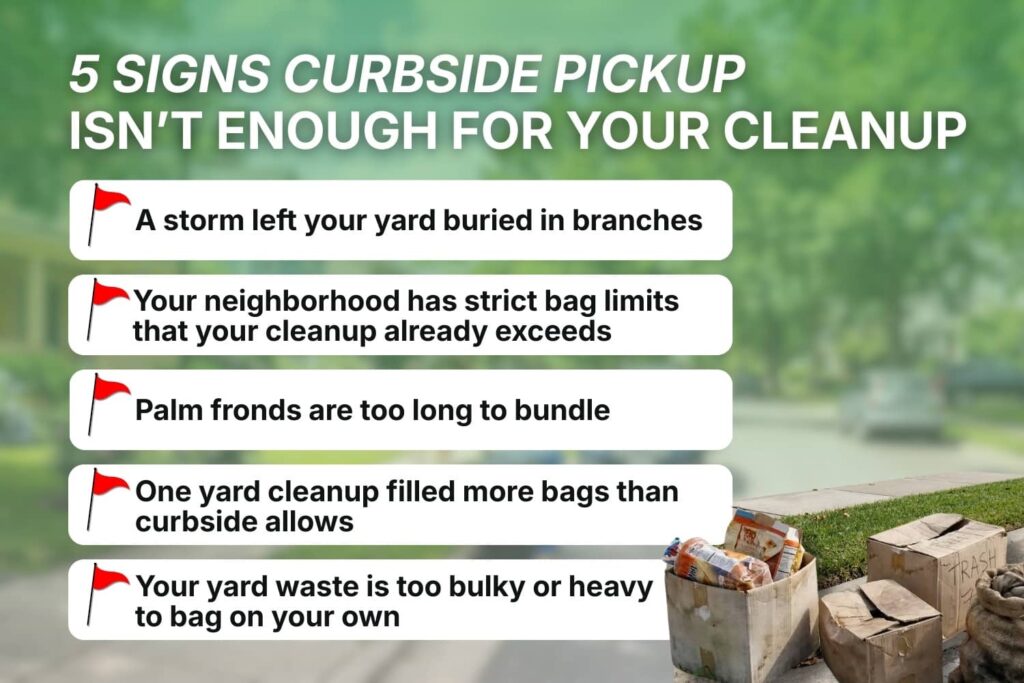
In Pasco County, branches must be under 4 feet long and 6 inches in diameter. Containers can’t exceed 50 pounds or 35 gallons, and you’re limited to 6 items per pickup day (no more than 3 cubic yards total). Pasco operates on a private hauler system, so your specific pickup day depends on your provider.
In Hillsborough County, WM handles curbside service. The weekly limit is 2 cubic yards, which increases to 3 cubic yards between February and April during peak landscaping season.
Across Texas, limits vary even more. Houston allows up to 8 cubic yards on heavy trash weeks.
Austin residents can put out a full compost cart plus 15 additional bags. Dallas offers a monthly collection with a generous 10 cubic yard cap. San Antonio, however, only offers brush collection twice per year, making it one of the most restrictive schedules in the region.
Curbside is a great option for regular maintenance. But once your cleanup exceeds a typical week’s worth, you’ll likely need another solution.
2. Drop-Off at a Local Facility
If you have access to a truck or trailer, dropping yard waste off at a local transfer station or recycling facility is a solid option for larger loads.
In Pasco County, residents can use the East Pasco Transfer Station in Dade City or the West Pasco Resource Recovery facility in Spring Hill. The cost is approximately $4.24 per 100 pounds. Proof of residency is required.
In Hillsborough County, residents get 2 tons of free yard waste disposal per year at county facilities. Free mulch is also available at select locations, a nice bonus if you’re working on a landscaping project.
In Texas, Houston operates free depository centers for residents. Dallas offers free self-haul drop-off for up to 20 cubic yards annually. Austin charges around $4.33 per cubic yard at its drop-off sites.
This method works well if you can consolidate your yard waste into a single haul. It takes more effort than curbside, but gives you more flexibility on volume.
3. Composting and Mulching at Home
For homeowners who want to cut down on waste and give back to their lawn and garden, composting and mulching are worth considering.
Grasscycling, the practice of leaving grass clippings on the lawn after mowing, is one of the simplest things you can do. Research shows it can reduce your lawn’s nitrogen fertilizer needs by 25 to 50 percent. The clippings break down quickly and return nutrients directly to the soil.
Backyard composting works well for leaves, small trimmings, and plant material. A basic compost bin can be set up in a corner of your yard. Compost-amended soil can retain up to 2.5 times more water than untreated soil, which is a real advantage during Florida’s dry season or a Texas summer drought.
Wood chipping is another option for branches and shrub trimmings. You can rent a chipper for around $70 per day, or hire a tree service that often leaves the chips behind for free.
Additionally, tree debris removal services are available if you prefer not to handle the cleanup yourself.
One thing to be aware of: some HOAs in FL and TX restrict composting bins or require them to be screened from view. Check your community rules before setting one up.
4. Renting a Dumpster
For major landscaping projects, large seasonal cleanups, or property renovations that generate significant yard debris, a dumpster rental gives you a dedicated container to fill on your own schedule.
Rental costs typically range from $150 to $800 or more, depending on the size and your location. Most dumpsters hold between 10 and 20 cubic yards of material.
The tradeoff is that you do all the loading yourself, and some areas require a permit if the dumpster sits on a public street. It also requires planning ahead since you need to schedule delivery and pickup, which doesn’t work well for urgent cleanups.
5. Burning (Where It’s Allowed)
In rural parts of Florida and Texas, burning yard waste is legal under the right conditions. But it’s not a practical option for most suburban homeowners.
In Florida, open burning is regulated by the Florida Forest Service. Permits may be required, and burning is often restricted during dry conditions or high fire danger periods. Most municipalities and HOAs prohibit it outright.
In Texas, burn bans are common during dry seasons, particularly in Central and West Texas. Many cities, including Houston, Austin, Dallas, and San Antonio, ban open burning entirely.
Even where it’s technically allowed, burning green material like palm fronds or freshly cut grass produces heavy smoke and is generally not recommended. If you’re in a rural area with legal burn options, dry, seasoned wood debris is the safest candidate.
6. Hiring a Yard Waste Removal Service
When the volume is too large, the material is too bulky, or you simply don’t have the time, hiring a professional yard waste removal service is the most straightforward solution.
A professional yard waste removal service handles everything from loading to hauling to disposal. There are no volume limits, no bagging requirements, and no waiting for a specific collection day.
This option works especially well for:
- Palm frond piles that are too bulky for standard curbside pickup
- Large branch piles after tree trimming or storm cleanup
- Post-storm debris that exceeds your weekly curbside limit
- HOA deadline pressure when you need the yard cleared fast
- Rental properties or estate cleanouts with accumulated debris
A good yard waste removal service will tell you upfront how they handle materials. Look for one that prioritizes composting or recycling over sending everything straight to a landfill.
Know Your Local Yard Waste Rules Before Pickup Day
Local rules can be confusing, especially if you’ve recently moved or your hauler has changed. Here’s a quick reference for the markets covered in this guide.
| Location | Pickup Frequency | Volume Limit | Bag Type | Branch Limit | Drop-Off Cost |
|---|---|---|---|---|---|
| Pasco County, FL | Weekly (private hauler) | 6 items / 3 cu yds | Paper/biodegradable | 4 ft / 6 in diameter | ~$4.24 / 100 lbs |
| Hillsborough County, FL | Weekly | 2–3 cu yds | Paper | 4 ft / 6 in diameter | 2 tons/yr free |
| Houston, TX | Weekly (heavy trash weeks) | 8 cu yds | Compostable | 3 in diameter | Free |
| Austin, TX | Weekly | Cart + 15 extras | Paper only | 5 ft / 3 in diameter | ~$4.33 / cu yd |
| Dallas, TX | Monthly | 10 cu yds | Paper preferred | 10 ft / 8 in diameter | Free |
| San Antonio, TX | Twice per year | 8 cu yds | Paper for leaves | General brush | ~$0.25 / 20 lbs |
Keep in mind that HOA rules can add another layer on top of municipal guidelines. When in doubt, check directly with your waste provider or visit your county’s solid waste website.
When Curbside Pickup Isn’t Enough
Curbside collection is convenient for everyday yard maintenance, but it has clear limits. Here are the situations where it tends to fall short for FL and TX homeowners.
After a storm. Hurricane season runs from June through November in Florida and affects coastal Texas as well. After a significant storm, the volume of debris, including downed branches, uprooted shrubs, and palm fronds, can easily exceed weeks’ worth of your normal curbside allowance.
Government pickup programs for storm debris can take days or weeks to mobilize. For a faster cleanup, check out how to prepare for yard debris removal after a storm.
Palm frond buildup. Palm fronds are one of the most challenging yard waste types in Florida. They’re long, fibrous, and slow to break down. Many curbside programs have specific rules about how they can be bundled, and large volumes simply exceed the standard limits.
HOA pressure. If your homeowners’ association has given you a deadline to clear your yard, waiting for your next scheduled pickup day may not be an option.
Large landscaping projects. Clearing overgrown lots, installing new landscaping, or doing a seasonal deep-clean often generates far more debris than curbside can handle in a reasonable timeframe.
In any of these situations, an on-demand service gives you control over timing and volume without the constraints of the municipal system.
The Eco-Friendly Side of Yard Waste Disposal
How you dispose of yard waste matters more than most people realize.
Yard trimmings make up about 12.1% of all U.S. municipal solid waste, roughly 35.4 million tons per year. When organic material like grass and leaves ends up in a landfill, it breaks down without oxygen and produces methane.
Landfills are the third-largest source of human-related methane emissions in the U.S., and methane is significantly more potent than carbon dioxide as a greenhouse gas.
Florida has actually addressed this directly. State law bans yard waste from lined Class I landfills, pushing it toward composting facilities and mulching programs instead.
Texas takes an incentive-based approach, offering landfill operators financial refunds for composting yard waste rather than burying it.
The most eco-friendly options are composting, grasscycling, and mulching, which keep yard waste out of the waste stream entirely. But when volume or material type makes those options impractical, working with a service that prioritizes recycling and diversion is the next best thing.
Related Questions
Can I put yard waste in my regular trash bin?
In most FL and TX counties, yard waste should be separated from regular household trash. Mixing the two can result in your entire bin being skipped or your yard waste being rejected. Check with your local hauler for specific rules, or read how to deal with bulk yard waste removal.
Are plastic bags okay for yard waste in Florida and Texas?
Generally, no. Most counties in both states require paper bags or biodegradable bags for yard waste. Plastic bags prevent proper composting and are rejected by most processing facilities. Always check your local provider’s guidelines, and for bigger cleanups, see how bulk junk removal can help your summer cleanup.
What should I do with palm fronds in Florida?
Palm fronds can go out with curbside yard waste in most FL counties, but they need to be cut to size (typically under 4 feet) and bundled properly. For large quantities, your best options are dropping them off at a local transfer station or using an on-demand removal service that can handle bulk volumes without size restrictions.
Conclusion
Getting rid of yard waste doesn’t have to mean wrestling with bin limits, waiting weeks for a pickup, or making multiple trips to a transfer station.
For everyday maintenance, curbside collection and composting are practical and affordable. But when the pile gets bigger, after a storm, a major trim, or a seasonal cleanout, you need a solution that works on your schedule and handles any volume.
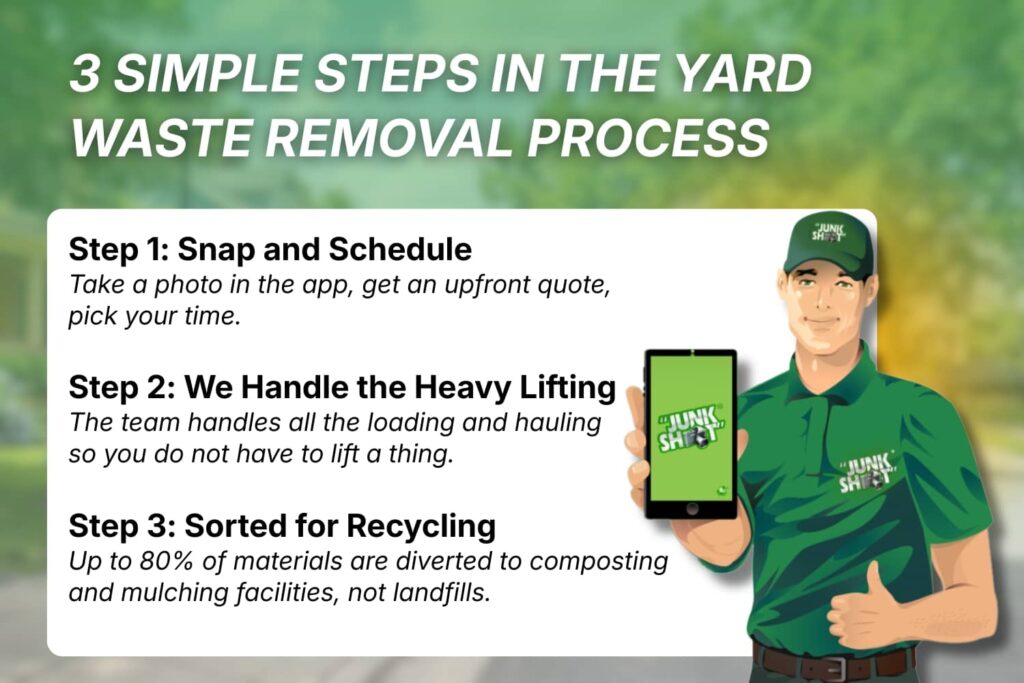
That’s where Junk Shot comes in. Snap a photo of your yard waste, get an upfront quote, and schedule a pickup at your convenience. No phone tag, no guessing on price, no heavy lifting on your end.
Download the Junk Shot app and see how simple yard cleanup can be. Or learn how it works if you want to know what to expect before you book.