Most closet organization problems are not actually organization problems. They are a too-much-stuff problem in disguise. You can buy all the bins, baskets, and shelf dividers you want, but if the closet is packed beyond its real capacity, no effort to organize is going to hold up for long.
The good news is that organizing a closet that feels completely overwhelmed is very doable. It just starts in a different place than most people expect.
Here is a practical, room-by-room approach that actually works, whether you are tackling a master bedroom closet, a hall closet, or a packed storage space somewhere in between.
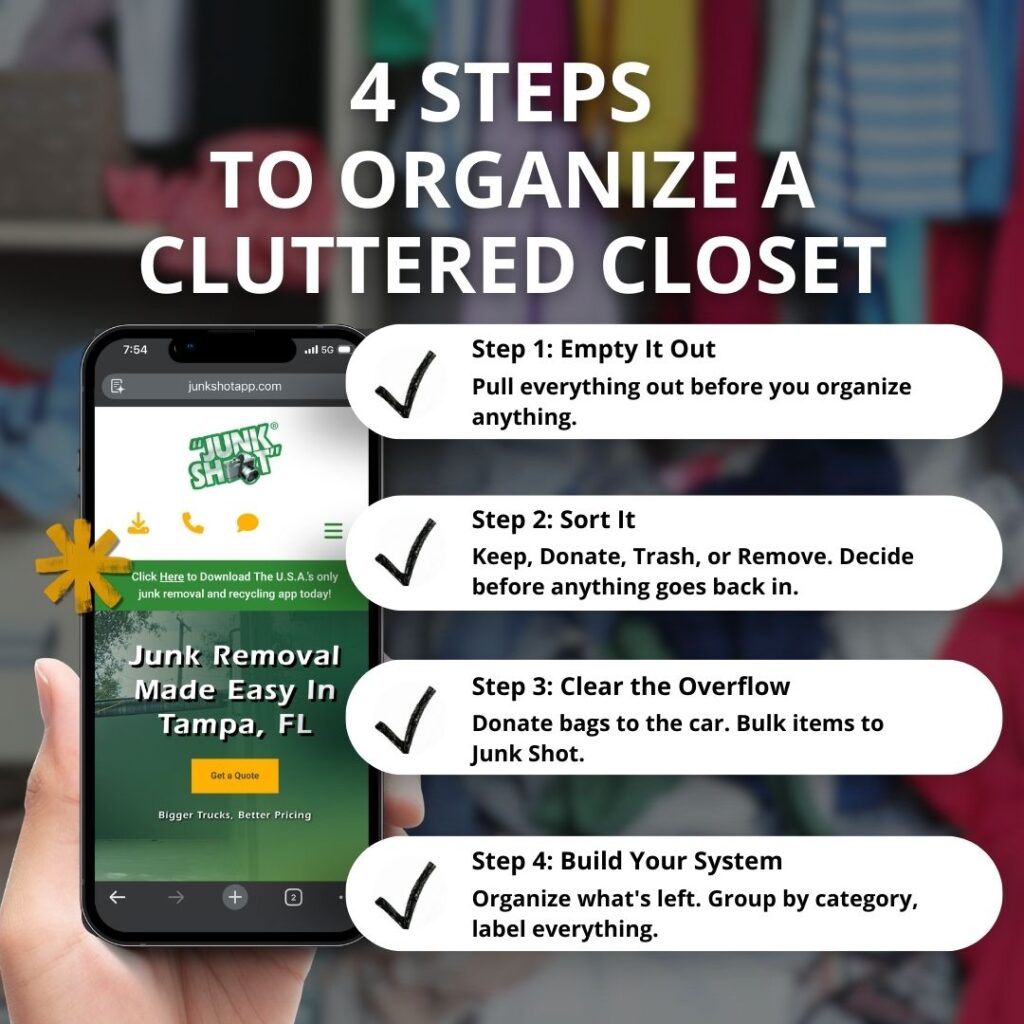
Step One: Empty It Out Completely
Before you organize anything, pull everything out. All of it. This step feels counterintuitive because the closet looks worse before it looks better, but it is the only way to actually see what you are working with.
Once everything is out, you can assess the space itself. Look at the overall size of the space, the shelving, the rod placement, and any floor space that might be usable. You may find that the layout is part of the problem and that a few simple changes to how the space is structured would help more than any storage product.
You will also find things you forgot you owned. That is normal and actually useful, because it forces you to make a decision about each item rather than just shoving it back in.
Step Two: Sort Before You Organize
This is where most closet projects go wrong. People start organizing before they have finished editing, which means they are just rearranging the same overload into a slightly tidier pile.
Sort everything into four categories before a single item goes back in:
- Keep: Items you use regularly and genuinely want
- Donate: Things in good condition that someone else could use
- Trash: Broken, worn out, or unsalvageable items
- Remove: Bulky or oversized items that need a different solution
That last category is worth paying attention to. Closets in Tampa homes often end up storing things that have no business being there: old furniture pieces, boxes of items from a past move, holiday decor that has multiplied over the years, and items that were “temporarily” stored and never moved.
These do not belong in a closet organization system. They belong somewhere else, or they belong gone.
Step Three: Deal With the Overflow First
Before you put anything back, handle the items that came out of the closet and should not go back in. Donate bags can go straight to the car. Trash can go to the bin. But that “Remove” pile is where Tampa homeowners often get stuck.
Large, awkward, or heavy items are not easy to deal with on your own. Old furniture, bags of items from a cleanout, bulky seasonal gear, and anything else that does not fit neatly into a donation box tend to sit in the hallway for weeks, which defeats the whole purpose of the project.
This is exactly the kind of job a junk removal service is built for. A full home cleanout or a single pickup of overflow items from a closet project can clear the path quickly so the organizing work actually gets finished.
Step Four: Group What Stays and Build Your System Around It
Now that the closet only holds what actually belongs, you can design a system that fits the real contents. Group items by category first, then by frequency of use.
Bedroom closets:
- Hang clothing you wear regularly at eye level and within easy reach
- Seasonal or occasional items go on higher shelves or toward the back
- Shoes do better on a low shelf or a simple rack than piled on the floor
- Accessories, folded items, and smaller pieces benefit from drawer organizers or clear bins
Hall and linen closets:
- Group by household category: linens together, cleaning supplies together, first aid together
- Use labeled bins or baskets for anything small or loose
- Keep frequently used items at the front, rarely used items toward the back or on higher shelves
Storage closets:
- Vertical space is your best friend; use it with adjustable shelving if possible
- Store heavier items low and lighter items high
- Clear bins let you see contents without pulling everything out
- Label everything, even if it seems obvious now
The goal is not a Pinterest-perfect closet. It is a closet where you can find what you need in under ten seconds without moving five other things first.
Closet Types That Need a Different Approach
Not every closet is a standard bedroom or hall closet. A few common situations worth addressing separately:
- Walk-in closets tend to accumulate more because there is more room to hide things. Apply the same sorting process, but be extra honest during the edit. The extra square footage is not an invitation to keep more; it is an opportunity to have a genuinely functional space.
- Reach-in closets have limited depth, which means anything stored more than one layer deep becomes invisible and forgotten. Use the full height of the space with additional shelving and keep the floor clear if possible.
- Utility and catch-all closets are usually the most overwhelming because they collect everything that does not have an obvious home. Before organizing, ask whether some of the contents belong in a different room entirely and whether anything bulky should simply be removed.
Other Questions Homeowners Ask
What is the best way to reduce waste when decluttering?
Separating items into donate, recycle, and trash piles before anything leaves the house makes a real difference. Items in good condition can go to local donation centers, while electronics, appliances, and other materials often have specific recycling options.
How do I get rid of furniture and large items I no longer want?
Bulky items like couches, dressers, and bed frames are not accepted through standard curbside pickup in most Tampa neighborhoods.
Options include donating pieces in good condition, scheduling a home cleanout service, or using a hauling service that handles large item removal without requiring you to break anything down yourself.
When does a closet cleanout turn into a full home cleanout?
More often than expected. A closet project frequently uncovers items stored throughout the house that have been ignored for years, especially in homes going through a move, an estate transition, or a major life change.
When that happens, a room-by-room cleanout is often the more practical approach.
When to Call for Backup
Some closet projects stay manageable from start to finish.
Others uncover a much bigger situation: boxes from a past move that never got unpacked, furniture pieces that have been quietly stored for years, or the accumulated overflow from an entire household that ran out of room.
If your closet cleanout turns into something larger, that is okay. Home cleanouts, moving and hauling services, and single-item pickups are all options that make it easier to follow through on the project rather than letting the overflow pile sit until next time.
Conclusion
Trying to organize a closet when you have too much stuff is really a two-part job: editing what you own, then organizing what remains. Skip the first part, and the second will not stick.
Start with a full empty-out, sort honestly, remove what does not belong, and build your system around what is actually staying.
For anything that needs to leave the house and is too big or too much to handle on your own, Junk Shot Tampa is available Monday through Saturday to haul it away and help you finish the job.